KEYNOTE QUANTUM-/SUPERCOMPUTING · GS1 EXCELLENCE DAYS 2026 · ZÜRICH-OERLIKON
Supercomputing for the supply chain: preparing for the quantum era with today’s machines
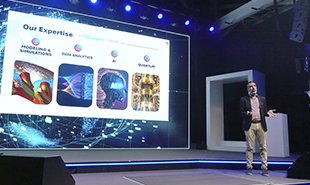
Dr Francesco Bongiovanni showed at GS1 stage the benefits of high-performance computing (Source: Markus Frutig)
Modern supply chains have outgrown the spreadsheet. At the GS1 Excellence Days 2026 in Zürich-Oerlikon, Dr Francesco Bongiovanni from “LuxProvide” in Luxemburg showed how high-performance computing already streamlines logistics today – and why especially Swiss logistics companies should build quantum-readiness now, long before the first fault-tolerant quantum computers arrive.
By Markus Frutig, Swiss Editor-in-chief logisticsinnovation.org

Dr Francesco Bongiovanni, Supercomputing specialist at LuxProvide held his keynote at GS1 Excellence Days 2026 in Zurich: getting ready for quantum with the computers we already have. (Source: LuxProvide)
When optimisation becomes a computing problem
Modern supply chains are a maze of moving parts: fluctuating demand, volatile inventory, intricate global delivery networks and constant pressure to cut costs without losing reliability. Spreadsheets and classical planning tools were never built for this scale. “Not every use case is about quantum,” Bongiovanni told the audience. “Most of them are about optimisation.” That is precisely where a supercomputer earns its keep.
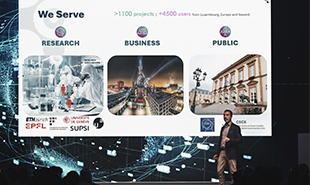
Bongiovanni’s advice in Zurich: “As a participating EuroHPC state, Switzerland can access these supercomputing machines – at no cost for eligible projects.” (Source: GS1)
LuxProvide operates MeluXina, Luxembourg’s national supercomputer and part of the EuroHPC network of European high-performance systems. The 30.4-million-euro machine entered production in 2021, ranked among the 50 most powerful computers in the world and remains one of the most energy-efficient. Crucially for Swiss companies: as a participating EuroHPC state, Switzerland can access these machines – at no cost for eligible projects.
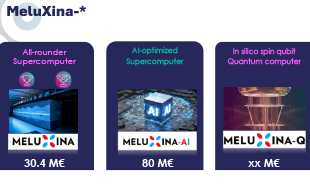
The MeluXina family: the 30.4-million-euro all-rounder in production, the AI-optimised system to be announced shortly, and the planned spin-qubit quantum computer MeluXina-Q. (Source: LuxProvide)
Four levers for logistics
LuxProvide structures its industrial offering around four levers that map directly onto logistics challenges. The first is AI and high-fidelity simulation: intelligent analytics and advanced simulations that streamline processes, raise efficiency and lower operating costs. The second is predictive maintenance and quality assurance: machine-learning models that flag failures before they happen, reduce downtime and keep product quality consistent. The third is optimised logistics: accurate forecasting, agile planning and continuous performance improvement across the supply chain. The fourth is smarter design: high-resolution structural and fluid-dynamic simulation that shortens development cycles and improves product durability.
The supply-chain case is the clearest. Running deep data analytics and simulation on MeluXina, a company can build a detailed digital model of its entire network – and gain a level of visibility and foresight that classical tools cannot match. Delivery routes, inventory levels and demand swings can be optimised continuously; disruptions can be anticipated rather than merely absorbed. The pay-off, according to LuxProvide, is lower operating costs, more resilient operations, more reliable deliveries and, through better-planned routes, reduced fuel consumption and emissions.
Security and sovereignty by design
For logistics firms, operational data is sensitive: routes, volumes, customers, margins. Bongiovanni was emphatic that trust is a precondition, not an afterthought. MeluXina sits in a Tier IV data centre – the highest availability class, with everything redundant – representing an 80-million-euro investment on its own. LuxProvide is ISO 27001 certified and engineered the system so that one tenant can never see another’s workloads.
“We were set up to be industry-first,” he explained. The logic is simple: a machine reliable and secure enough for industry is more than good enough for research. Many industrial partners, he noted, would not even start a conversation without that certification in place.
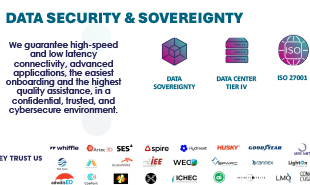
Trust as a precondition: Tier IV data centre, ISO 27001 and data sovereignty – with industrial users ranging from SES and Goodyear to RSS Hydro and HydroSat. (Source: LuxProvide)
Excellence in practice
The keynote’s use cases showed the range. Satellite operator SES, headquartered in Luxembourg, used MeluXina to optimise the placement of its next-generation constellation, achieving with eleven satellites the coverage that once required twenty – a saving measured in hundreds of millions. After the 2021 floods that hit Luxembourg, Belgium and Germany, flood-mapping specialist RSS Hydro ported its software from CPU to GPU on the machine and gained a tenfold speed-up – decisive when authorities need inundation maps fast.
“Quantum advantage starts way before quantum supremacy.”
Dr Francesco Bongiovanni, LuxProvide
Precision-farming firm HydroSat combined its models with high-resolution satellite imagery to help farmers raise yields while saving water. And the European Centre for Medium-Range Weather Forecasts is building a digital twin of the planet, replaying 35 years of data to predict extreme events more accurately. Each of these is, at heart, an optimisation or resilience problem – the same class of problem that defines modern logistics.

Network optimisation in practice: with MeluXina, SES delivers global coverage using eleven next-generation satellites instead of twenty. (Source: LuxProvide / SES)
The three horizons of quantum value
Bongiovanni framed the road ahead as climbing a mountain in three horizons. Horizon one is now: build the skills and the infrastructure. Horizon two – combining classical computing with today’s noisy quantum processors in hybrid workflows. LuxProvide is actively preparing this stage: it will soon launch the procurement of MeluXina-Q, an in-silicon spin-qubit quantum computer that reuses Europe’s existing semiconductor base – a technology for which an 18-nanometre process is, as he put it, the “perfect sweet spot.” Horizon three, fault-tolerant quantum computing, is expected around 2030.
The energy argument is striking. A quantum machine may draw around 50 kilowatts; an AI cluster packed with GPUs runs at two megawatts, and some of the largest existing systems can easily reach 50 to 70 MW. “This is not sustainable,” he said. Quantum’s efficiency could become a hard advantage once power is the binding constraint.

Three horizons to quantum value – from skills and infrastructure today to fault-tolerant machines later, and the crossover where quantum overtakes classical computing for hard problems. (Source: LuxProvide)
The no-regret investment
What should a company do today that still pays off even if quantum arrives late? Bongiovanni’s answer was unambiguous: invest in modelling skills, and specifically in the diagrammatic approach drawn from category theory. Even without a quantum computer, expressing a complex system as a string diagram brings clarity – and because the underlying frameworks are highly parallelized, it delivers real speed-ups on classical machines too. He pointed to the ZX-calculus, which let him cut a search algorithm from sixteen quantum gates to four, and to a study in which 82 per cent of high-school students passed a graduate-level quantum exam after learning the method. “If high schoolers can do it, so can you.”
The second prerequisite is good data, which means open standards. HPC suffered for decades from machines that could not talk to each other; quantum computing, learning the lesson early, agreed on OpenQASM open specifications from the start. Winners, he argued, will have the best data, the best models and the best decision loops – plus the compute agility to add quantum when it is ready.
A Swiss takeaway
For a Swiss audience the message lands twice. The optimisation problems at the core of logistics – routing, scheduling, network design, demand forecasting – are exactly where supercomputing already delivers, and where quantum could one day excel. And the door is open: through EuroHPC, Swiss companies can already access machines like MeluXina, with LuxProvide’s experts on hand to guide the first steps.
As Bongiovanni put it, quantum advantage starts well before quantum hardware – and the time especially for Swiss companies to get ready is now. “Because if you don’t,” he warned, “competitors will!”
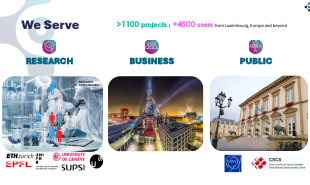
In the heart of the European supercomputing ecosystem – with Swiss users including ETH Zurich, EPFL, CERN and the Swiss National Supercomputing Centre CSCS. (Source: LuxProvide)
ABOUT

(Source: LuxProvide)
Dr Francesco Bongiovanni leads the Supercomputing Application Services group at LuxProvide SA and played a key role in developing Luxembourg’s HPC infrastructure, including the MeluXina supercomputer. He holds a PhD in Distributed Systems from INRIA and has more than a decade of experience in HPC and cloud computing.
More informations about industry & logistics simulation solutions: www.luxprovide.lu/sector-solutions/industry-logistics/
LuxProvide SA operates MeluXina on behalf of the Luxembourg state and is part of the EuroHPC network of European supercomputers. luxprovide.lu